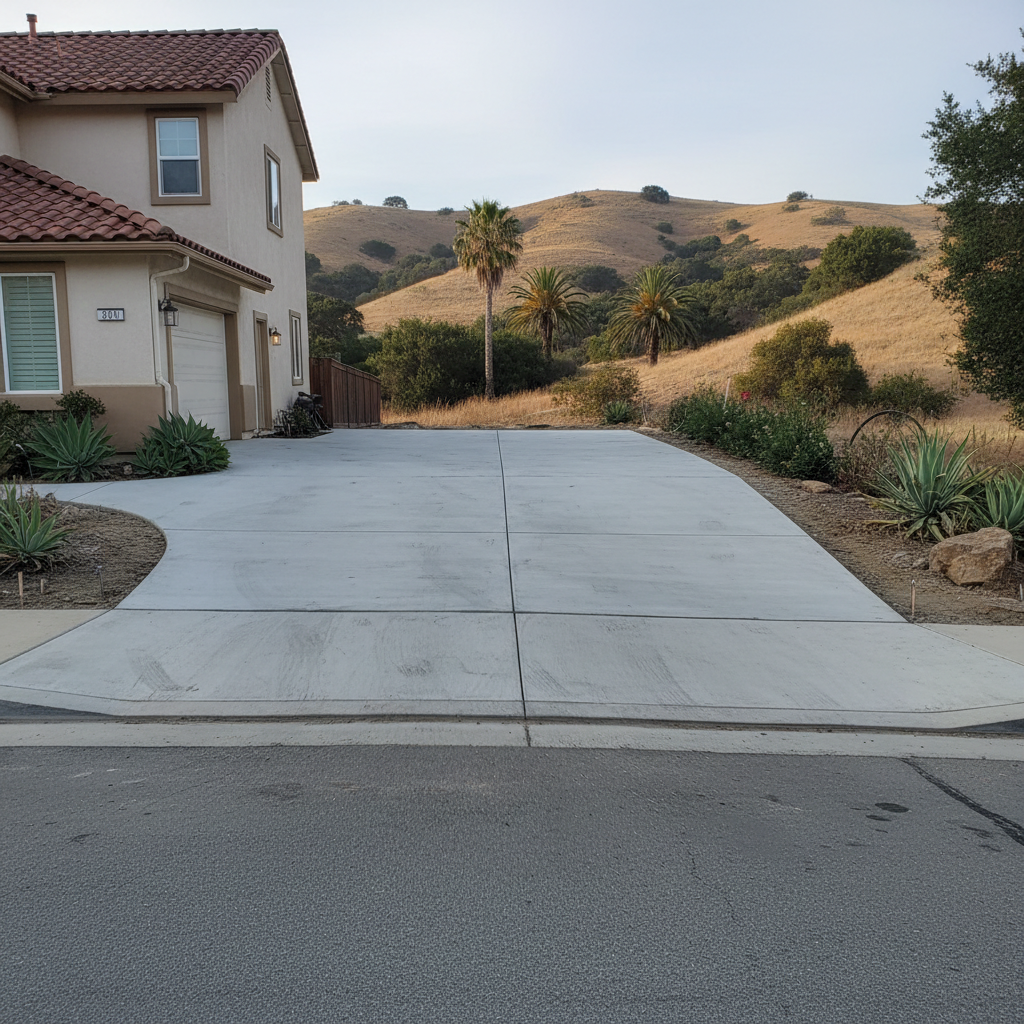
A driveway or a patio slab is one of the few things on a house that's genuinely hard to undo. Paint you can redo in a weekend. A bad concrete pour means renting a breaker, hauling out the chunks, and paying for the whole job twice. Before you sign anything, it's worth knowing what separates a contractor who knows what they're doing from one who's just good at quoting a low number.
Start with the license, not the price
In California, flatwork and foundation work fall under a C-8 concrete contractor license through the CSLB. Ask for the number and look it up yourself on the state's website. It takes two minutes and tells you whether the license is active, whether there's a bond on file, and whether there are complaints against it. A lot of guys working in Downey and Bellflower and Norwalk are perfectly competent and unlicensed, running under someone else's number or no number at all. That might be fine for a small patch job. It is not fine for a driveway apron that ties into city sidewalk, or a retaining wall holding back dirt next to your foundation.
Ask about liability insurance too, not just workers' comp. If a crew's saw kicks a chunk of concrete through your neighbor's fence, you want that covered by their policy, not yours.
What the bid should actually spell out
A real bid names the slab thickness, the base prep, and the reinforcement. If it just says "driveway, $X," ask questions.
- Thickness: 4 inches is standard for a driveway or patio. If you're parking an RV or a dually, you want 5 to 6 inches, or thickened edges where the tires track.
- Base: a few inches of compacted class II road base under the slab, not just concrete poured over graded dirt. Skipping this is the single most common shortcut, and it's the one you can't see once the slab is down.
- Steel: #3 or #4 rebar on an 18-inch grid holds a driveway together through root heave and soil movement far better than wire mesh, which tends to sink to the bottom of the pour and do almost nothing. Mesh is cheaper and still common. Ask which one is in the bid.
- Mix strength: 3,000 PSI is typical for residential flatwork, 3,500 to 4,000 for areas that'll see heavier loads or stamped decorative work.
- Control joints: cut every 8 to 10 feet on a 4-inch slab, within 24 to 48 hours of the pour. Concrete is going to crack somewhere as it shrinks and cures. A joint tells it where. Skip the joints and you get a crack running diagonally through the middle of your new patio.
Downey's ground and weather do matter here
Most of Downey sits on old San Gabriel River floodplain soil, a mix of sandy loam with pockets of denser clay, especially closer to the river and in the older neighborhoods east of Paramount Boulevard. Clay swells when it's wet and shrinks when it dries, and that movement under a slab is what causes the slow, hairline cracking you see in a lot of 1950s driveways around town. A contractor who's worked here knows to compact the base properly and not just pour straight onto whatever's there, especially after a wet winter when the ground is still carrying moisture.
The weather itself is forgiving compared to a lot of the country. We don't get real freeze-thaw cycles, so you're not dealing with the kind of spalling that ruins concrete in colder states. The risk here runs the other way: heat. Pour on an August afternoon when it's 95 degrees and low humidity, and the surface can dry out faster than the concrete underneath cures, which leads to crazing and a weaker top layer. Good crews pour early morning in summer and keep the slab damp or covered for the first few days. Rain is the other factor, mostly November through March. A slab poured during or right before a storm without proper cover can wash out or finish rough.
Plan on 5 to 7 days before you drive on a new driveway, and closer to 28 days before the concrete hits its full design strength. Walking on it after a day or two is fine. Parking a car on it after two days is how you get tire marks pressed into soft concrete.
Permits aren't optional, and they're not hard
The City of Downey's Building and Safety division permits slab foundations, retaining walls over a certain height, and most structural flatwork. If your driveway ties into the public sidewalk or street, that part usually needs a separate encroachment permit through Public Works, since you're working in the public right-of-way. A decorative backyard patio that isn't attached to the house structurally often doesn't need the same level of review, but a retaining wall holding back more than a couple feet of soil generally does, and for good reason. Downey has very few HOAs outside of some of the newer townhome developments, so for most single-family lots the city is the only approval you're dealing with. A contractor who tells you permits aren't necessary, or who wants to skip the inspection, is asking you to take on liability that should be theirs.
What to walk away from
A bid that's dramatically lower than two others usually means something's getting cut: less rebar, thinner slab, no base prep, or a crew that pours and runs without coming back to saw-cut joints properly. A contractor who wants full payment up front, in cash, with nothing in writing, is not someone you want holding your money if the weather turns or the job stalls halfway through demo.
Older Downey neighborhoods, the ones built in the postwar tract boom of the late 1940s and 1950s, often have shallow sewer laterals, old sprinkler lines, and sometimes abandoned clay pipe sitting right where a new driveway or walkway is going. A contractor who hasn't called for utility locates before digging is gambling with your yard, and possibly your water line. Ask how they handle demo and removal of the old slab, too. Broken-up concrete has to go somewhere, and a legitimate contractor hauls it to a real disposal or recycling site, not into a dumpster at a job down the street.
We've been doing driveways, patios, retaining walls, and slab work around Downey long enough to know which streets have soil that needs extra base, and which ones drain fine on their own. If you want a straight answer on what a job actually needs before you spend anything, take a look at our concrete contractor work or give us a call.